
AI in Radiation Detection: From Data Overload to Decision Support
AI is being used to interpret radiation data, reduce false alarms, and support faster operational decisions. This article reviews how AI is currently applied in systems such as RadNet, EURDEP, SPEEDI, and border-monitoring networks, alongside research from DARPA and the IAEA.

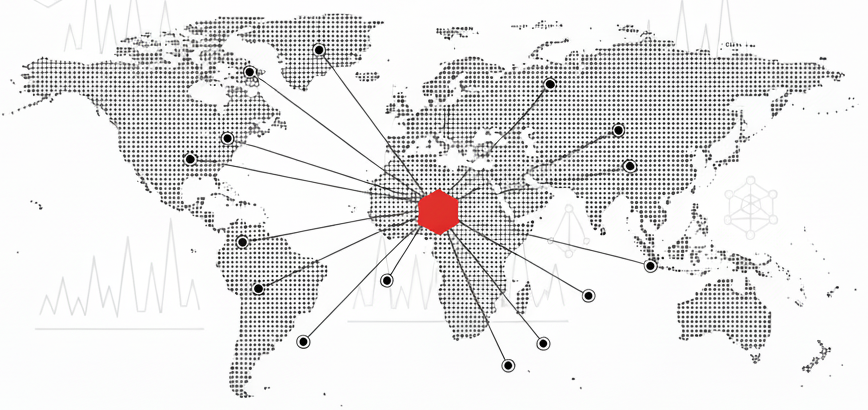
A practical review of how artificial intelligence is reshaping radiation monitoring and security operations
1. Introduction: Data without Context
Radiation detection networks today generate large, continuous data streams from fixed, mobile, and spectroscopic detectors.
Systems such as EPA RadNet and EURDEP produce millions of readings daily, most of which represent normal background radiation.
The operational challenge is to isolate meaningful deviations within that noise.
Artificial intelligence (AI) is being introduced as an analytical layer — improving how large datasets are processed, interpreted, and prioritised.
Its purpose is not to automate decisions but to enable faster, evidence-based situational awareness.
2. How AI Fits into Existing Systems
AI in radiation monitoring typically operates between the raw sensor data and human analysts. Its role includes:
- Data pre-processing: cleaning and synchronising readings from multiple instrument types.
- Pattern recognition: establishing location-specific baseline radiation behaviour over time.
- Anomaly scoring: ranking deviations according to probability and severity.
Research within U.S. national laboratories shows that unsupervised learning methods can detect emerging anomalies several hours earlier than conventional threshold systems.
At ports and border checkpoints, AI-assisted algorithms embedded in Radiation Portal Monitors (RPMs) adjust to site-specific background radiation, reducing unnecessary alarms caused by natural radioactivity in common materials.
3. Operational Reference Systems
United States – RadNet and RPM Networks
The EPA’s RadNet includes more than 140 air-monitoring stations operating 24/7 (EPA, RadNet).
Its time-stamped data provide a foundation for AI models that learn seasonal and geographical background variations.
The Department of Homeland Security’s RPM network, screening millions of cargo containers annually, is testing AI-based alarm analysis under the DARPA SIGMA program.
Early field results show that AI classifiers can cut NORM-related false positives while maintaining sensitivity to potential illicit sources.
Europe – EURDEP
The European Radiological Data Exchange Platform (EURDEP) aggregates data from over 5,500 automatic monitoring stations across 39 countries (JRC EURDEP).
Its XML-based data model and harmonised QA protocols make it one of the most mature transnational monitoring frameworks.
AI trials are exploring regional anomaly detection by correlating dose-rate data with meteorological patterns and satellite observations.
Japan – SPEEDI and Successors
Japan’s System for Prediction of Environmental Emergency Dose Information (SPEEDI) combines sensor, meteorological, and topographical data to model radiological plume dispersion during emergencies.
Although deterministic in origin, the latest research integrates machine-learning meteorological models to improve accuracy in predicting airborne contaminant movement and deposition.
4. Technical Contributions of AI
4.1 Anomaly Detection and Contextual Filtering
Machine-learning models (e.g., gradient boosting, random forest, neural networks) classify unusual readings based on temporal and spatial context.
At DOE pilot sites, automated anomaly detection reduced manual data review time by up to 70 %.
4.2 Spectral Interpretation and False-Alarm Reduction
Ceramics, fertilizers, and other goods with K-40, U-238, or Th-232 isotopes often trigger false alarms.
AI-assisted spectral classifiers can learn isotope signatures and improve separation of benign and suspect sources.
DARPA’s SIGMA+ phase extends this through sensor fusion — combining gamma, neutron, and contextual data for improved classification accuracy.
4.3 Predictive Maintenance
Detector calibration drift and component ageing are significant sources of error.
Predictive algorithms trained on historical calibration data can flag instruments requiring service before performance degrades.
Several commercial suppliers are now embedding this function in RPM software.
5. Integration Challenges
Adoption remains uneven due to technical and organisational constraints:
- Data integrity and interoperability: non-standard formats and incomplete metadata hinder multi-network analysis.
- Cybersecurity: connected sensors are potential attack vectors; model manipulation or data spoofing could distort readings.
- Model transparency: explainability is essential for regulatory acceptance.
- Human oversight: operator trust depends on verified performance metrics and clear responsibility lines.
The IAEA and regional regulators are developing guidance for cybersecurity and validation of AI applications in radiation monitoring.
6. Decision Support in Practice
AI-driven analytics are most effective when embedded within established command structures.
They can:
- Prioritise alerts requiring expert review.
- Merge environmental and security datasets into unified dashboards.
- Provide near-real-time cross-border correlation during incidents.
In simulations conducted by European research groups, automated EURDEP cross-correlation reduced event characterisation times from several hours to under 20 minutes.
7. Market and Industry Outlook
AI in radiation detection is transitioning from pilot projects to selective operational use.
Key developments include:
- Government-funded programs: DARPA’s SIGMA+, DOE’s AI for Radiological Security Initiative, and the European Commission’s Euratom Horizon research calls focusing on intelligent monitoring.
- Industry participation:
- Mirion Technologies and Thermo Fisher Scientific have introduced modular AI analytics in RPM and handheld systems.
- Kromek and Arktis Radiation Detectors are developing integrated software platforms for dynamic background learning and data fusion.
- Technology readiness: TRL 6–8 for anomaly detection and false-alarm reduction modules; TRL 4–6 for predictive maintenance and cross-network correlation.
- Market trend: increasing demand for data interoperability, secure APIs, and audit trails in detector management software.
AI integration is likely to appear first in national and regional command platforms, followed by selective deployment in field devices as validation frameworks mature.
8. Outlook
AI will not replace existing monitoring infrastructure. Its contribution lies in improving efficiency, consistency, and reaction time within established systems.
The decisive factor for future adoption will be trust — both in the integrity of data and in the governance of automated analytical processes.
References
- U.S. Environmental Protection Agency – RadNet Overview
- European Commission Joint Research Centre – EURDEP Advanced Map
- Sangiorgi et al. Earth Syst. Sci. Data 12 (2020): 109–118 – “25 Years of Monitoring Data Exchange (EURDEP)”
- DARPA – SIGMA Radiation Detection Program
- IAEA – “Enhancing Emergency Preparedness and Response Through Effective Cooperation and Information Exchange” (2023)
- National Academies of Sciences – Improving Detection of Radiological Materials Through Data Analytics (2022)